
Biography
Macau, 1951 — Porto
Son of a journalist and a champion sprinter, curator at twenty-seven, the designer of a city’s coins, stamps and marks, Macau’s first fashion designer, a columnist for twenty years — and, throughout, a Macanese playing what he calls the Macanese game.
Origins · 1925–1951
A photograph, 1925
There is a photograph of the teaching staff of the Liceu de Macau, taken in 1925. Among the seated men are Camilo Pessanha, the Symbolist poet of Clepsidra, and Manuel da Silva Mendes, lawyer, president of the Leal Senado and one of the great early collectors of Chinese art. Among their pupils were a young athlete, António Maria da Conceição, who in 1928 and 1930 would be Portugal’s national relay champion, and a young woman, Deolinda do Carmo Salvado, who would become the territory’s first woman journalist.
Deolinda — teacher, writer, author of Cheong-Sam · A Cabaia, survivor with her two elder sons of a Japanese internment camp in Hong Kong — was, in her son’s words, “very certainly the first emancipated woman of Macau”, and the city punished her for it. Her stories are almost all about Chinese women; he believes she could write them because she had suffered enough to be open to the gaze of the other.
Their son, born in 1951 and given his father’s name, would in 1978 become the first full-time curator of the museum built on Silva Mendes’s collection. Three generations pass through one photograph.


António Conceição Júnior · On his mother, 2024
Childhood · 1951–1963
San Pat Kano, the new eight houses


He was born on 6 December 1951 at the Hospital de São Rafael — today the Consulate of Portugal — and grew up in the Bairro Governador Albano de Oliveira, eight houses for civil servants that the Chinese called San Pat Kano. His parents were the first to live in theirs; it was the last to be demolished.
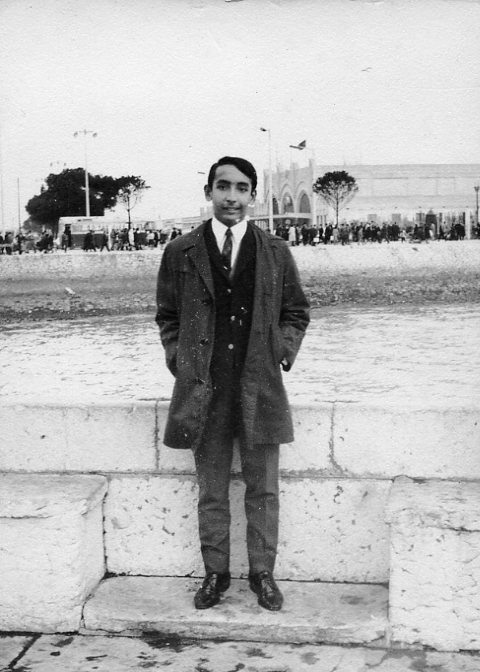
His mother died in 1956, when he was five. A boarder at the Colégio Dom Bosco, a Sporting supporter in his father’s colours, a boy photographed on his father’s Nash and beside the kung-fu master Kwan Tak Hing, he had read every Enid Blyton in Macau by twelve and argued his father into sending him to a college in Portugal.
The journey was its own education. At Rangoon airport the barman wore an evening jacket over a sarong: “the top was Western, but then there was the sarong. There it was, my discovery of differences.”
António Conceição Júnior · 2024
Lisbon and Macau · 1963–1977
The plate, the proof and the edition
Back in Macau at fourteen, he directed, drew and wrote a youth page in Notícias de Macau, the newspaper his parents had helped to make; at sixteen his caricatures and oil paintings filled his first solo exhibition. In 1968 he entered the Lisbon School of Fine Arts beside Fernando Calhau and Julião Sarmento, and learned engraving at the Gravura cooperative under João Hogan.
Military service took him home in 1972. The army lent him to the Liceu as drawing master, and he was in a classroom on the Praia Grande on 25 April 1974 when two officers walked in to announce that Portugal had changed. One of them, Garcia Leandro, would later send for him as governor.
In between: a young teacher’s life in Vila Franca de Xira, a daughter, Beatriz, and the graphic novel Wong Fei Hong · O Vento de Shantung (1976) — an older China, drawn from memory rather than slogans, that took him to the comics congress in Lucca and fixed the rule he would later call the Macanese game.


António Conceição Júnior · 1998
The museum and the city · 1978–1991
The invention of a profession


In January 1978, aged twenty-seven and the sole candidate, he became curator-director of the Museu Luís de Camões and inherited a collection documented on hand-corrected carbon sheets. Within two years he had photographed every piece, restored the building with the Gulbenkian, opened Macau’s first temporary exhibition gallery and taken the territory to Lisbon: the Quinzena de Macau of 1980 was the first time the colony presented itself to Portugal as a culture rather than a possession.
Then the requests began. Between 1982 and 1998 the government asked one man to design its coinage and its base stamp issue; to mark its cleaning campaign, its hospital, its airport and its banks; to found its designers’ association, direct its arts festival, advise its governor and run its cultural department. In a territory without a design profession, the one trained designer became the profession. As Vítor Marreiros puts it, he wrote, with his work, the ABCs of design in this city.
António Conceição Júnior · On his years in public service
Power and authority · 1988–1999
The unbuilt, and the handover
In 1988 Governor Carlos Melancia made him cultural adviser and asked him for a Cultural Complex: a museum, two auditoria and an art and design school for all of East Asia on piles over the outer harbour, financed by a hotel and congress centre so that it would cost the public purse nothing. In 1991 Melancia fell; the project was called megalomaniac and shelved.
A decade later a smaller Centro Cultural was built, and no one knew what to put in it. The president of the Leal Senado brought him the floor plans over tea, and he laid out the boxed Camões collection from his memory of the 1978 inventory. That is the Museu de Arte de Macau. In 1999 his design won the competition for the medal of the transfer of sovereignty; the edition of two thousand was struck and never distributed. The same year he declined the Medal of Cultural Merit.


António Conceição Júnior · On the Cultural Complex, 1991
Aikido
Aikido, or the absence of envy


He describes aikido not as a martial art but as the disposition underneath everything: a philosophy that recognises the primacy of nature, practised by an aikideshi who is always a student and never a teacher. Preparing the ballet O Som do Leque for the 1997 Macau Arts Festival, he went back to the mat and found it had been under all his work — a tranquillity, a non-competitiveness, a solidarity with colleagues.
It is why the polyvalence never became self-promotion, and why so much of what he made is anonymous in the city that still uses it. He never signed the leaf.
António Conceição Júnior · On aikido
Citizen · 1998–2019
A place of citizenship
He left public service in 1998, founded ARS CIVES and began writing weekly for the Portuguese-language press of Macau — Lugar de Cidadania, Entreposto, Conversas do Chá e do Café, Urbanidades. For the Museu de Arte de Macau he curated the first exhibition anywhere on the history of steel in East Asia and brought the Louvre’s Plato in the Lands of Confucius; in his father’s memory he revived and chaired Sporting Clube de Macau.
Three books gathered the columns, each launched twice, in Macau and in Lisbon. Albums and exhibitions followed — Primum Lumen, Trânsitos, Territórios — and lectures on Silva Mendes, Afonso de Albuquerque and the Macanese.


António Conceição Júnior · On Macau after the handover, 1998
Porto · 2019–
The last workshop


In 2019 he moved to Porto, where he draws, paints and writes in a study he calls his last workshop. He organises his writings, researches the history of Macau, returns to the portrait, and in 2026 became a member of the Sociedade de Geografia de Lisboa.
He was filmed in Porto and in Macau for a documentary directed by his son, António; a monograph of the work, in Portuguese, English and Traditional Chinese, is in preparation.
António Conceição Júnior · 1997
What others wrote
Maria de Jesus Barroso
Carlos Morais José
Pedro Tamen
Fernanda Dias
Read all the testimonials →